Community-based Conservation and Sustainable Utilization of Potential Medicinal Plants in Rasuwa,
Nepal Himalaya
Sponsor: Plantlife International, UK
Collabrators: Manekor Society Nepal (MSN), Rasuwa and Federation of Community Forest User Groups Nepal (FECOFUN),
Rasuwa
Executant: ESON
Project Duration: September 1st, 2006 – August 31st, 2007.
Team members: KK Shrestha (Team Leader), RC Poudel (Project Coordinator), K Humagain and S Yadav (M. Sc. students), KS
Tamang and B Poudel (Field Associates, Rasuwa), K Lama (Field Assistant); NN Tiwari, S Rajbhandary, I Shrestha (Research
Associates)
ESON conducted a project on community based in situ conservation of medicinal plants in the Rasuwa district of Nepal
Himalaya. This project is entirely a Community Participatory Action oriented program. For better effectiveness of the project
activities, ESON selected two local organizations MSN and FECOFUN having tendency to work with the remote communities
and strong community favour, relationships and sound prestige among local people. Each project activities were conducted
in close collaboration with local authorities and related stakeholders of the project area with specific objectives:
- To find out the priority medicinal plants of local communities and understand local conservation efforts if any,
along with their availability, distribution, regeneration, local use, trade and livelihood of the local people.
- Raise awareness among local communities on sustainable use and management of medicinal plants and encourage
them to institutionalize their activities from a single common team (committee) for better communication,
coordination and exchange of learning’s on sustainable utilization, management and growing of medicinal herbs.
- Formation of medicinal plant management and monitoring team in the village.
- Building capacity of Community Forest User Groups in inventory and assessment of medicinal plants to develop habitat
monitoring and annual sustainable harvesting plan.
- Based on the resolution of this first phase of study, develop community based Action plan for follow up project mainly
in situ and ex situ conservation of medicinal plants.
| From the beginning, the project was leaded by the communities of Chilime Village Development Committee (VDC) outside the National Park and Thulo syafru, inside Langtang National
Park, so achievement so far made by the project is entirely the
dedication of the field staffs and the local communities.
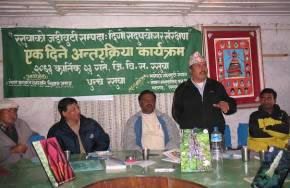
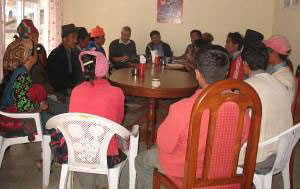
The first activity was by organizing the Inception meeting (6th
November 2006) at the District headquarter on "Conservation
and Sustainable utilization of the medicinal Plants of Rasuwa
district". The meeting was participated by more than 35
persons representing 20 organizations including leading
government and non government organizations/institutions of
the district. Mr. Bharat Luitel, Act. Chief District Officer was the
Chief Guest of the program and the program was conducted under the chairmanship of Dr. Krishna K Shrestha (President,
ESON). The meeting concentrated on the following issues. 1. Identification and assessment of medicinal plants; 2.Ways of
sustainable utilization of the medicinal plants; 3. Need and importance of participatory conservation of medicinal plants;
and 4. Identify and minimize the challenges seen in the medicinal plant sector.
|
This was followed by more infomal community meeting organized at Chilime VDC. This meeting was participated by all the
sixteen community forest representatives of Chilime VDC. In this meeting, they exchanged their medicinal plants
management practices and disscussed the challenges they were facing in the sustainable management and utilization of
MAPs and at the end resource mapping of their respective community forest user groups was done.
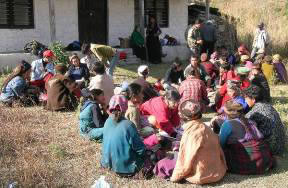
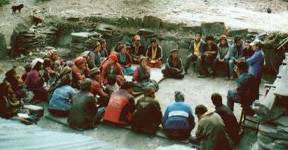
After about three month long gap due to snow fall in the
villages, one day, village level workshop was done in the
Mangtang Village on 2nd February 2007, which provided very
good opportunities for the forest users to decide what was to
be done in future. The workshop was attended by more than
40 community forest users representing six community forests
of Brapche, Mangtang, Tetangche, Tatopani, Gongau and
Paragaun villages. The workshop was also participated by local
NGOs working in different sector of social services.
| 
|
| Langtang National Park is not only rich in biodiversity and
high quality medicinal plant but also a unique assemblage of
natural beauty, with many small glacier lakes above 4000m.
Gosaikunda is one main lake having religious value which is
visited annually by more than 50,000 Hindu and Buddhist
pilgrims during the month of August in the full moon, and
several species are in high threats from these pilgrims. Along
the route of lake, collection of herbs during the fair time by
the pilgrims is very common. Due to irrational collection most
of the herbs are hardly seen along the route. To raise awarness
among the pilgrims and make the people more responsible for
developing guardianship of the resources, “Free Herbal Health
Care Camp and Awareness Raising Campaign” was organised in
August 25‐29, 2007.
|
| “Two free herbal health camps” were conducted at the height
of 3500m in Cholangpati and 4400m in Gosaikunda near the
holy lake. Pilgrims having problems like altitude sickness,
headache, leg pains were checked by the herbal doctors and
prescribed herbal medicines. About 1000 pilgrims were served
during the fair. The campaign was organized in close collaboration with Gosaikunda Management Committee, Nepal Army
of Dhunche, Scout of Dhunche, and Nepal Red Cross society, Dhunche. During this program, pamphlets with many useful
information about altitude sickness and importance of biodiversity and herbs, were distributed to the pilgrims and
attractive posters/banners were sticked/hangged along the route.
Apart from these activities, the research team of the project
coducted series of ethnobotanical and ecological studies to
assess the local uses and trade value of medicinal plants, their
population dynamics and distribution pattern in the study
areas. Each study was done based on widely used
methodologies, the data were analysed and the result acquired
was fitted to the successive activities of the project.
|
The field research was accomplished by a group of botanists
including the Project Coordinator Mr. Ram C Poudel and two M.
Sc. students namely, Mr. Kamal Humagain and Ms. Saroj Yadav
for their partial fulfillment of Master degree course in the form
of M. Sc. dissertation. During the survey the research team also encountered high trade of medicinal herbs in the Northern
VDCs of Rasuwa district, harvested from the community forests as well as illegal harvesting done from the national park. In
this regard, series of meeting have been conducted by ESON with the national park authorities and have also supported the
medicinal plants growers too. To address this issue, a half day workshop was organized in Syafrubesi on 10th May 2007 with
the representatives of buffer zone management council of Langtang National Park. The workshop was participated by altoghether 25 participants including Plantlife International Program Manager Dr. Alan Hamilton, ESON‐Allachy project
Team Leader Dr. Krishna K. Shrestha, Project Coordinator Mr. Ram C Poudel, MSN President Mr. Kaisang Tamang and
FECOFUN District President Mr. Binod Poudel.
|  |
A monitoring team has also been formed within the 5 CFs of Mangtang, Tetangche, Simbu, Tatopani and Paragaun villages.
In the meetings they updated the situation of medicinal plants in their CFs and worked for the existing problems following
simple scientific tactices, a half day meeting on 10th May 2007 and one week (12‐18 May, 2007) long field based training in
the Kaltache Community Forest was conducted. In week long duration, community were trained in the major methods of
inventory, handling simple measuring tools, herbarium preparation, plant identification, and developing annual harvesting
plan.
|
|